
Abstract
Context
Cultivated grasslands developed via advanced agronomic practices serve as a critical source of supplementary feed and high-quality forage for animal husbandry. Elymus nutans, the most ecologically versatile and widely cultivated forage grass on the Qinghai-Xizang Plateau (QZP), is highly prized for its exceptional forage quality and sustained high yields.
Objective
This study aims to assess the dynamic in forage yield, carbon (C) sequestration, resource utilization efficiency, physiological parameters, and economic income of Elymus nutans over a 5-year planting cycle in cultivated grasslands of the eastern QZP from 2012 to 2022.
Methods
An eddy covariance flux tower equipped with a full suite of meteorological sensors was established on the cultivated grassland to assess the high-frequency ecosystem-level exchanges of CO2, H2O, and biometeorological parameters. Meanwhile, forage bio-physical parameters, including above-ground biomass (AGB) and leaf area index (LAI), were measured during the growing season (May–September). The flux data were processed, quality-checked, gap-filled, and partitioned to construct seamless time-series of daily flux for further analysis of its dynamics, photosynthetic responses, and derived eco-physiological parameters.
Results
The results showed that within 5-year planting cycle, the gross primary productivity (GPP) displayed a unimodal pattern, reaching their peak in the third year at 823.87 ± 97.54 g C m⁻² yr⁻¹ . Meanwhile, C uptake period and the maximum daily GPP jointly accounted for 83 % of the variation in GPP. The AGB initially increased and then stabilized, reaching a peak of 665.17 ± 84.83 g/m² in the second year. The LAI followed similar unimodal patterns, with peaks in the second year at 2.18 ± 0.67 m²/m². Regarding resource use efficiency, C use efficiency remained relatively stable at 0.04 ± 0.013, while water use efficiency and light use efficiency displayed unimodal dynamics. Physiological parameters (apparent quantum yield, α; maximum carboxylation rate, Pmax; daytime ecosystem respiration rate, Rd) all showed unimodal changes, with peak values observed in the second year. Over five years, Elymus nutans grasslands produced 2.73 t/ha seeds and 19 t/ha forage, generating CNY 43,894.75 in economic income. They also sequestered 6.64 t/ha CO₂, corresponding to a C trading value of CNY 453.51.
Conclusion
These results confirm that a 5-year reploughing regime for Elymus nutans grasslands represents a viable strategy to sustain forage yields, maintain C sink functionality, secure economic income, and optimize resource utilization. This study provides critical empirical support and a strategic framework for the adaptive management and sustainable development of perennial cultivated grasslands on the QZP.
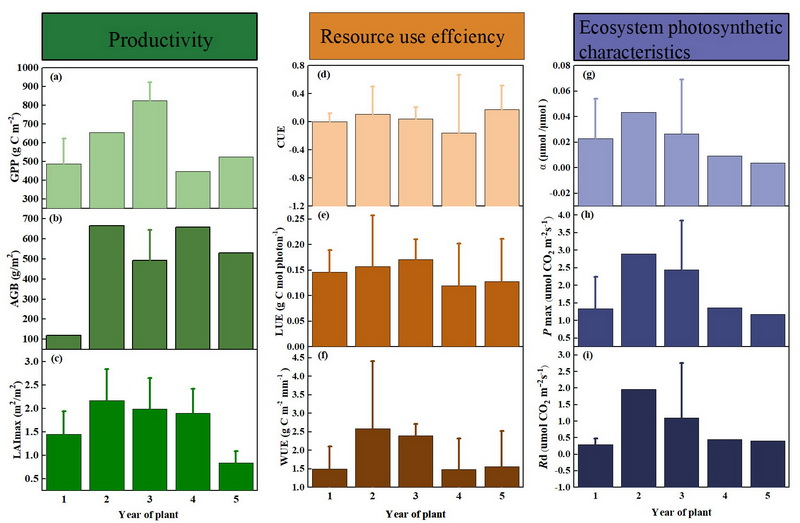
Fig. 7. Dynamic of the annual cumulative gross primary productivity (GPP, a), aboveground biomass (AGB, b), leaf area index (LAI, c), carbon use efficiency (CUE, d), light use efficiency (LUE, e), water use efficiency (WUE, f), ecosystem apparent quantum yield (α, g), maximum rate of gross CO2 assimilation (Pmax, h) and daytime ecosystem respiration rate (Rd, i) in different year of plant.
The link below will guide you to the reading:
https://www.sciencedirect.com/science/article/pii/S0378429025005799?dgcid=coauthor