
As the hinterland of the Qinghai-Tibet Plateau, the Sanjiangyuan region possesses pivotal ecological and strategic value, with its soil quality serving as a cornerstone for regional and global ecological balance. However, under the coupled stressors of climate warming and intensifying anthropogenic activities, the accumulation of soil potentially toxic elements (PTEs) has accelerated markedly, posing a substantial environmental threat to this fragile ecosystem. To unravel the driving mechanisms governing soil PTE contamination, this study focused on the alpine grasslands of Sanjiangyuan, analyzing the concentrations of five priority PTEs (Pb, Cd, Cr, As, and Hg). Employing an integrated framework that couples spatial interpolation, correlation analysis, and Positive Matrix Factorization (PMF), we systematically disentangled how elevation, climatic factors, soil physicochemical properties, and anthropogenic disturbances shape the spatial distribution patterns and variability of soil PTEs. Results indicated that: (1) Soil PTE concentrations exhibited a unimodal distribution along the elevational gradient, peaking at intermediate altitudes, and showed significant positive correlations with mean annual precipitation (MAP) and vegetation cover (p < 0.05). Spatially, concentrations displayed a distinct decreasing gradient from the southern region toward the eastern and northwestern sectors. Notably, the southern region was characterized by the highest contaminant loads (Pb: 16.47 ± 3.82, Cd: 0.10 ± 0.02, Cr: 52.78 ± 7.56, As: 14.45 ± 2.35, Hg: 0.041 ± 0.004 mg kg−1), whereas the northwestern region presented the lowest values (Pb: 8.41 ± 1.10, Cd: 0.04 ± 0.002, Cr: 30.47 ± 3.48, As: 11.89 ± 1.97, Hg: 0.017 ± 0.001 mg kg−1). (2) Reflecting its lithogenic origin, Cr exhibited significantly stronger correlations with key edaphic properties—including soil water content (SWC), pH, organic/inorganic carbon (SOC, SIC), total nitrogen (TN), and soil total phosphorus (STP)—compared to other PTEs. Notably, these associations were more robust in the subsurface layer (10–20 cm) than in the surface layer (0–10 cm). (3) Within the 0–20 cm soil profile, concentrations of PTEs exhibited a significant decline with increasing distance from anthropogenic disturbances. Pb showed the highest sensitivity to this spatial gradient, evidenced by a feature importance score of 30.05%. While this distance effect attenuated notably with soil depth, sharp concentration gradients were observed in the surface layer: Pb dropped from 12.45 ± 3.49 to 4.21 ± 0.82 mg kg−1, Cd from 0.071 ± 0.015 to 0.023 ± 0.001 mg kg−1, Cr from 53.97 ± 8.79 to 23.43 ± 4.22 mg kg−1, As from 13.21 ± 2.56 to 9.36 ± 1.64 mg kg−1, and Hg from 0.039 ± 0.002 to 0.013 ± 0.003 mg kg−1. (4) The PMF model identified four distinct source factors contributing to soil PTE accumulation. Traffic emissions and fossil fuel combustion (accounting for 32.1% of the total variation) were identified as the primary drivers for Pb and As. In comparison, Hg was predominantly associated with mixed anthropogenic sources (28.6%), while Cr was largely controlled by natural pedogenic processes (23.5%). Furthermore, Cd was mainly attributed to industrial and agricultural activities (15.8%). Spatially, soil PTE contamination in the Sanjiangyuan region is modulated by the complex interplay between external environmental drivers (elevation, MAP, mean annual temperature (MAT), and anthropogenic disturbances) and internal ecosystem factors (vegetation and soil properties). The driving mechanisms exhibit distinct vertical stratification: topsoil PTE accumulation is driven by the coupling of vegetation and soil factors, whereas subsoil variations are predominantly constrained by soil properties. Notably, anthropogenic influence is characterized by surface enrichment and attenuates rapidly with soil depth. Consequently, management strategies should prioritize stringent mitigation interventions in the southern region, while focusing on preventive conservation in the eastern and northwestern regions.
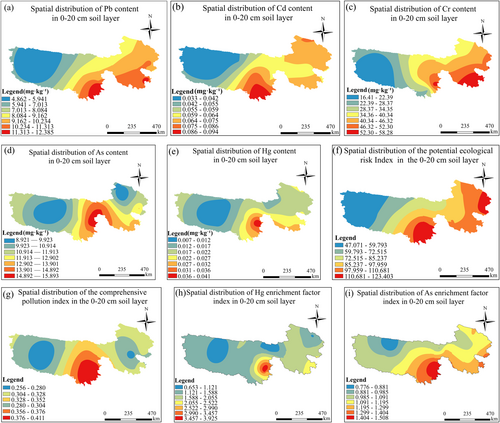
FIGURE 2
Spatial distribution of soil contents of potentially toxic elements, comprehensive pollution Index, and potential ecological risk index in the Sanjiangyuan region. (a–e) The spatial distributions of Pb, Cd, Cr, As, and Hg concentrations; (f–g) the spatial distributions of the RI and NPI; (h–i) the spatial distributions of the EF for Hg and As. [Colour figure can be viewed at wileyonlinelibrary.com]The link below will guide you to the reading: