
Understanding and quantifying the dietary composition of large carnivores is crucial for elucidating their functional roles within ecosystems including their top–down regulation of prey populations and their interactions with sympatric carnivore species. In this study, we employed DNA metabarcoding to analyze the vertebrate components of the diets of three sympatric large carnivores, snow leopard Panthera uncia, wolf Canis lupus, and brown bear Ursus arctos, with particular emphasis on assessing potential interspecific competition in the Sanjiangyuan Region (SR) of the Qinghai–Xizang Plateau. Analysis revealed 11, 16, and 17 prey species in the diets of wolves, snow leopards, and brown bears, respectively. Domestic yak (Bos grunniens) was the most frequently detected prey item in the diets of both wolves (Relative Read Abundance; RRA = 52.29%) and snow leopards (RRA = 25.42%), whereas brown bears primarily consumed plateau pikas (Ochotona curzoniae; RRA = 43.10%) and Himalayan marmots (Marmota himalayana; RRA = 19.88%). Although high dietary niche breadth overlap was observed between snow leopards and wolves (Ojk = 0.76) and between snow leopards and brown bears (Ojk = 0.79), potential interspecific competition may be mitigated through differential prey selection and varying consumption intensities. The relatively low dietary overlap between wolves and brown bears (Ojk = 0.32) implies that these two species likely coexist by partitioning trophic resources. Moreover, the substantial proportion of livestock found in the diet of these large carnivores indicates potential presence of significant human–carnivore conflict in the SR. Combined with previous findings, our results support the hypothesis that the abundance and size-class availability of ungulate prey are key factors enabling the sympatric existence of these three apex predators.
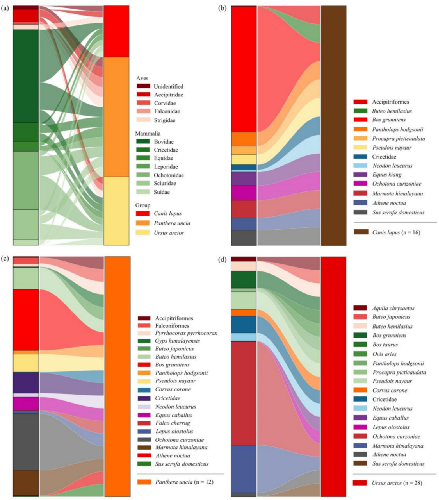
Dietary composition of three large carnivore species at the species level in the SR: (a) dietary composition at the family level; (b) Canis lupus; (c) Panthera uncia; (d) Ursus arctos. The color blocks on the left represent the relative read abundance (RRA), expressed as a percentage, of prey items identified at the family or species level, whereas those on the right indicate the sample sizes for each respective carnivore species, with block dimensions proportionally scaled to the number of samples. Numerical values in parentheses denote the number of fecal samples collected for each corresponding large carnivore species.
The link below will guide you to the reading: