
Yak is a unique Bos species that adapts to the extreme climate of the Qinghai-Tibet Plateau in part owing to its dense skin coat. Despite its essential role in cold adaptation, the genetic basis of hair follicle structure and growth has not been extensively studied in this iconic animal. In the present study, we construct a single-cell atlas of hair follicle (HF) cells from yak and taurine cattle and examine differences in their cellular composition and gene expression. Among the 14 cell types identified in HFs, the dermal papilla (DP) displays the most dramatic differences between cattle and yak. Detailed analysis reveals that the genes in the WNT signaling pathway are differentially expressed in the dermal papilla (DP) cells of yak. Using primary cultures of DP cells, we reveal that the inhibition or activation of WNT/β-Catenin dramatically alters cell cycle progression and autophagy. In complimentary with the ATAC-seq data, we show that SOX4 is directly associated with
the promoters of WNT1 and WNT3A. Interestingly, increased autophagy regulates the expression of SOX4/WNT/β-Catenin to promote the proliferation of DP cells in yak. Together, these results reveal the molecular signature of coat adaptation at the single-cell transcription level and provide a new understanding of animal adaptation to extreme environments.
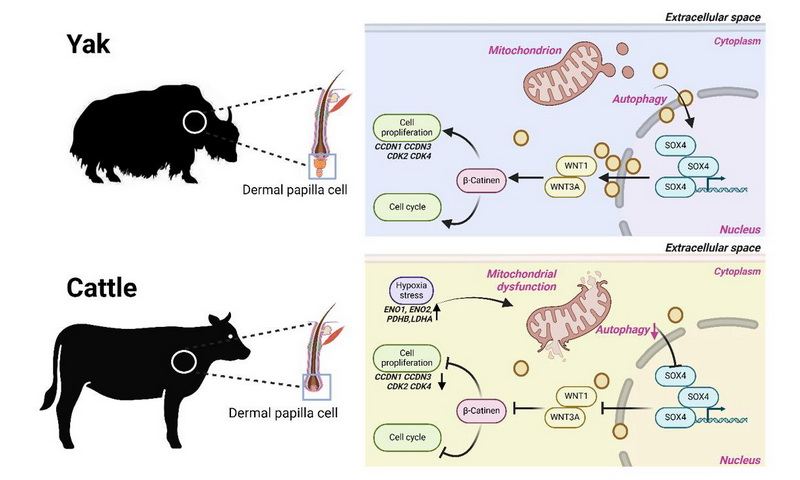
Schematic diagram showing that the SOX4-directed The WNT/β-Catenin pathway regulates the proliferation of dermal papilla cells in yak.
The link below will guide you to the reading:
https://www.nature.com/articles/s42003-025-09467-w