
Schizopygopsis malacanthus Herzenstein, 1891, a fish species native to the Qinghai-Tibetan Plateau, is widely distributed upstream of the Jinsha and Yalong Rivers. Comprehensive analyses were conducted on all geographic populations of S. malacanthus and the coexisting fish Herzensteinia microcephalus (Herzenstein, 1891). Morphological examination revealed that the Yalong River population of S. malacanthus can be distinguished from other Schizopygopsis species according to its phenotypic characteristics, including the origin of the ventral fin under the 4th–5th branched ray of the dorsal fin, strong unbranched rays of the dorsal fins, hooked pharyngeal bones, and shovel-shaped or oblique-truncated grinding surfaces of the pharyngeal teeth. The phylogenetic and genetic analyses revealed monophyly of the Yalong River population of S. malacanthus, with genetic distances ranging from 2.03––6.16% from those of other Schizopygopsis species. Consistent with the molecular evidence, species delimitation clearly revealed that the Yalong River population of S. malacanthus is distinct from other Schizopygopsis populations. Therefore, we present Schizopygopsis yalongensis sp. nov. as a valid species through integrative taxonomy, resolving the taxonomic ambiguity of the Schizopygopsis fishes in the Yalong River. These results increase known fish diversity and highlight cryptic species present in the river system of the Qinghai-Tibetan Plateau.
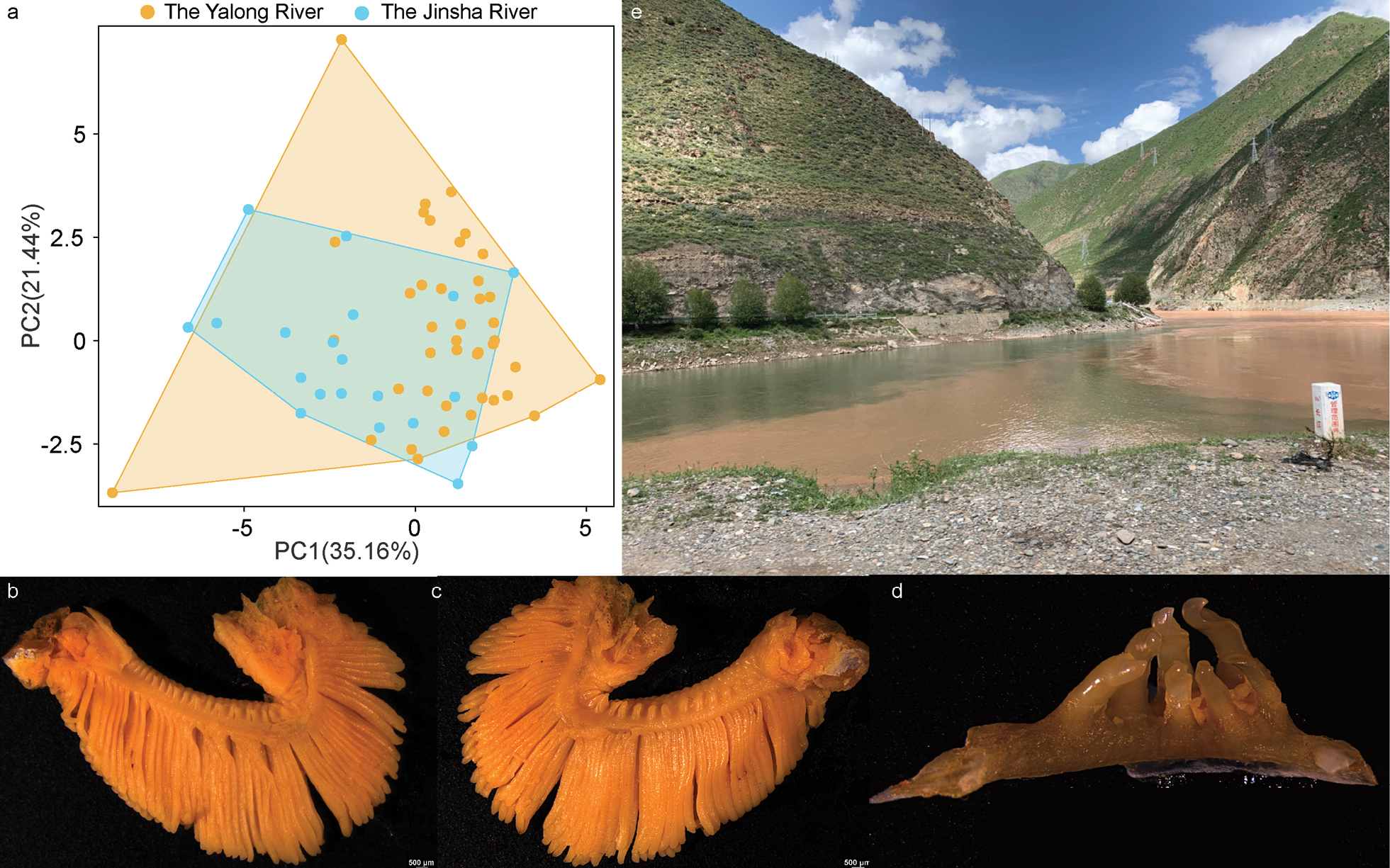
PCA for S. yalongensis (orange circles) and S. malacanthus (blue circles). a. The inside of the gill arch from the left side of S. yalongensis; b. The outside of the gill arch from the left side of S. yalongensis; c. The inside of the gill arch from the left side of S. malacanthus; d. The outside of the gill arch from the left side of S. malacanthus; e. The habit of S. malacanthus in the Tongtian River, which is upstream of the Jinsha River.
The link below will guide you to the reading: