
Climate change is expected to intensify over the coming decades, potentially exerting substantial impacts on above-ground net primary productivity (ANPP), a key indicator of ecosystem functioning and carbon sequestration. However, decadal cooling phases remain underexplored, and phenology is rarely integrated explicitly as a cascading mediator linking temperature to plant growth and ANPP. Consequently, the long-term effects of climate change—particularly those associated with cooling phases—remain poorly understood.
Based on a reciprocal transplant experiment initiated in 2007 in an alpine grassland, we measured ANPP, plant growth dynamics, flowering species composition, and phenological events.
After 15 years, ANPP increased under warming but decreased under cooling. However, only the warming effect intensified over time, whereas the cooling effect showed no detectable temporal trend. Importantly, both warming and cooling effects on ANPP were integrated by early-season phenology. Under warming conditions, earlier leaf-out and accelerated growth rates corresponded with higher ANPP. However, leaf and flower phenology showed decoupled cascading effects on growth under cooling conditions: delayed leaf-out inhibited plant growth, while delayed flowering partially mitigated this suppression.
Synthesis. Therefore, extrapolations based solely on short-term warming manipulations, neglecting both the differences in long-term warming effects and the cooling phases with their distinct ecological mechanisms, will lead to inaccurate long-term predictions. Our findings demonstrate that changes in plant phenological events mediate the impacts of decadal climate warming and cooling on ANPP in alpine grasslands, providing more comprehensive insights into how alpine ecosystem carbon cycling may respond to long-term climate change.
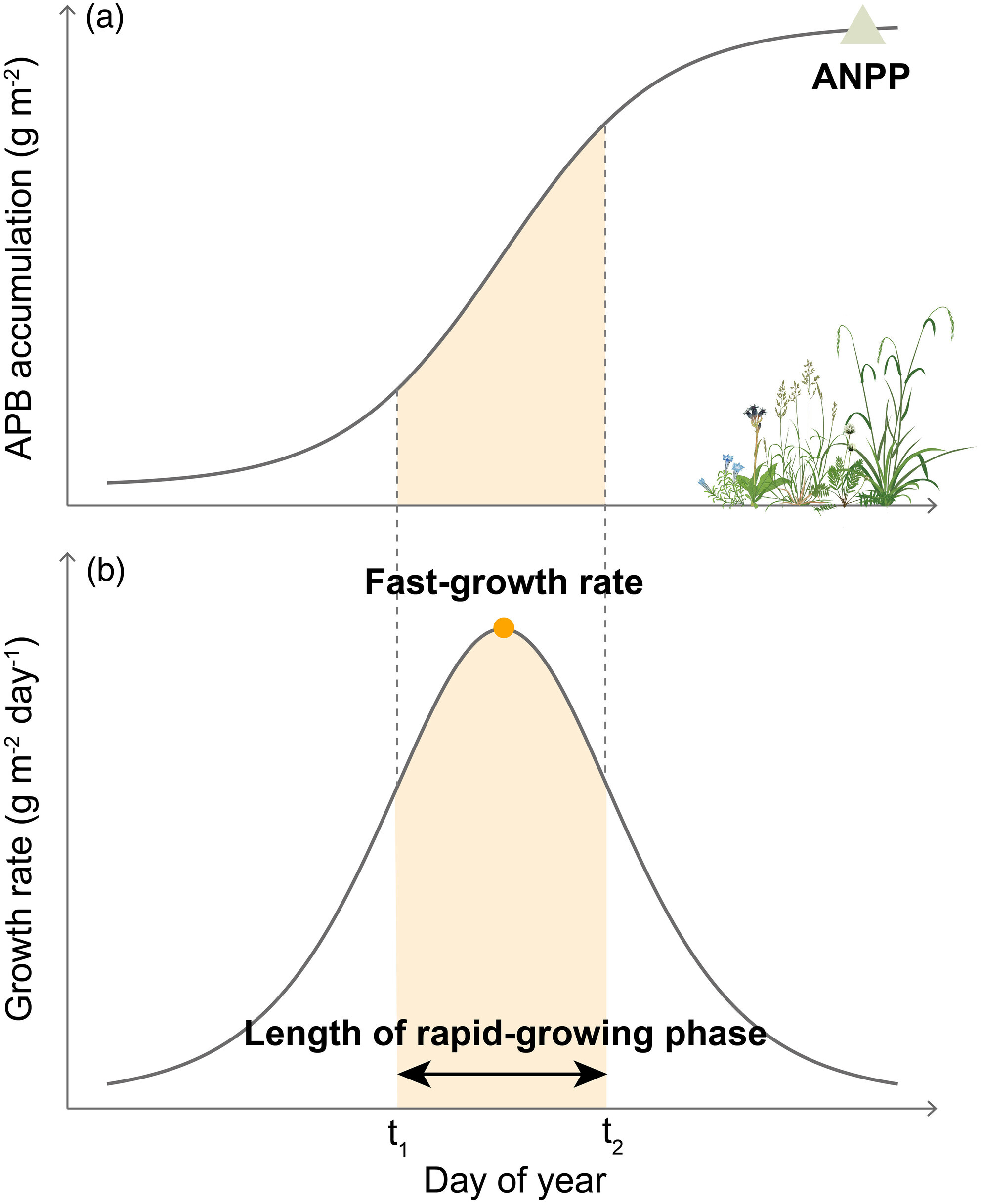
FIGURE 1
Conceptual illustration of the above-ground biomass accumulation and rapid-growing phase. (a) A schematic diagram illustrating the trajectory of above-ground present biomass (APB) accumulation, with above-ground net primary productivity (ANPP) as peak APB. (b) A schematic diagram showing temporal variation in plant growth rate, with peak as fast-growth rate. Time points t1 and t2 indicate the onset and end of the rapid-growing phase, respectively.
The link below will guide you to the reading: